Is there such a thing as correct Spanish and incorrect Spanish?
Is the Spanish spoken in Spain the only correct one?
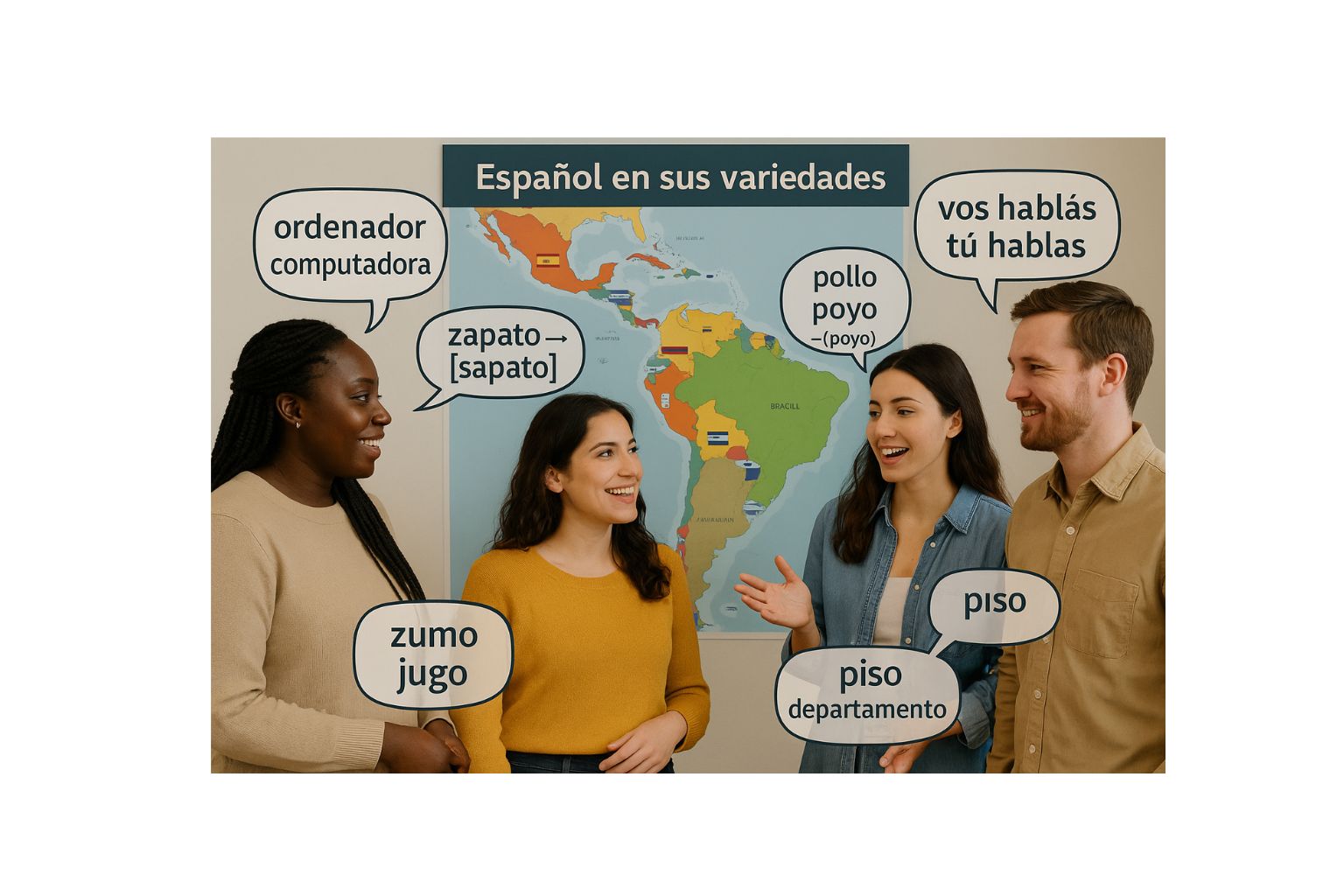
And in order to answer all of this, we need to broaden our perspective and look at it from two different approaches or roles: the teacher who teaches it and the student who learns it.As an ELE teacher (Spanish as a foreign language), more than once I’ve found myself influenced by institutions that ask teachers to teach the Spanish of Spain—or Castilian*—claiming that it’s “the correct one.” And since I have to meet the needs of those who request it, I teach the Spanish spoken in Spain, which, by the way, also has its own linguistic varieties. However, when I teach students who study at my online school, I like to tell them that Spanish is a very rich and diverse language, full of dialects and varieties.Although Castilian (the standard variety) is spoken in Spain, dialects and regional features exist within the country itself, such as those found in Andalusia. In the Americas, for example, people tend to pronounce everything as /s/, so the word zapato is pronounced like sapato. This phenomenon, known as seseo, occurs mainly among Spanish speakers from Andalusia, the Canary Islands, and in practically all of the Americas, and of course, it belongs to the educated standard in the places where it occurs.There is another phenomenon called yeísmo. The /ll/ phoneme (cuello, silla, muelle) and the /y/ phoneme (playa, reyes, suyo) are both pronounced as [y]: pollo and poyo are pronounced [póyo]. This phonetic phenomenon is widespread among most Spanish speakers in Spain and Latin America, and it is fully accepted.Another phenomenon we can talk about is voseo, which consists of using the pronoun vos and its corresponding verb forms instead of túto address someone informally in the second person singular:
Vos tenés, vos hablás, vos sos
Tú tienes, tú hablas, tú eres.
Voseo is standard (accepted and officially promoted) in: Argentina, Uruguay, Paraguay, Honduras, Nicaragua, and Costa Rica. And it is not standard, but it is widely used, in: Chile, Bolivia, El Salvador, Venezuela (the Andes), Ecuador, Guatemala, and Colombia (areas in Valle del Cauca and Antioquia).Sociolinguistic importance: voseo is no longer considered incorrect or vulgar; it is a marker of regional identity and a fully valid variety within Spanish. The RAE (Royal Spanish Academy) recognizes it and describes it in its grammars and dictionaries.Finally, we can say that the same reality is named differently depending on the region. For example:
SpainMexicoArgentina ordenador computadora computadora coche / carro auto auto zumo jugo jugo piso departamento departamento patata papa papa At this point, anyone who wants to take on the task of studying Spanish might ask: which Spanish should I learn? In my opinion, since learning requires time and effort, the best option would be to study Spanish with all its linguistic features, always adapting it to personal goals and needs. But it’s important to remember that there isn’t a correct Spanish and an incorrect Spanish. The Spanish spoken in all Spanish-speaking countries is correct.